In accordance with the Decree of the Government of the Republic of Kazakhstan No. 280 dated March 31, 2014 “On Approval of the Comprehensive Privatization Plan for 2014-2016”. Transtelecom JSC was included in the list of companies to be privatized and alienated in a competitive environment.
Thus, in May 2015, 49 percent of the Company’s shares were sold as a result of auctions conducted by National Company Kazakhstan Temir Zholy JSC by way of an open two-stage tender and by the Decree No. 107 of the Government of the Republic of Kazakhstan dated February 25, 2016.
In May 2018, another 26 percent stake minus one share in Transtelecom JSC was purchased as part of the second wave of privatization in an open two-stage tender.
In accordance with the resolution of the Board of Directors dated July 22, 2019 (Minutes No. 7/2019), it was decided to issue bonds in the domestic market for an amount not exceeding 22 billion tenge.
On January 10, 2020, National Management Holding Baiterek JSC purchased bonds of the Company, issued on the Kazakhstan Stock Exchange, in the amount of 10,000,000 thousand tenge with a coupon rate of 11.5% per annum.
As of December 31, 2020, the shareholders of the Company are as follows: National Company Kazakhstan Temir Zholy JSC – share of ownership
25%plus 1 share
Mukhanov M.S. – share of ownership
75%minus 1 share
A detailed historical background of the issue and placement of shares is reflected in the annual report for 2017 in the section “Share Capital Structure”.
As of December 31, 2020 the authorized
capital was formed in the amount of
thousand tenge
(twelve billion two hundred forty-one million four hundred eighty-seven thousand tenge)
The total number of authorized
common shares of the Company is
shares
No preference shares are provided.
The nominal value
of one share is
tenge
including: placed
5,638,097shares
not placed
832,992shares
Number of authorized
common shares
shares
The amount of funds raised
from the placement of shares
tenge
According to the bond issue prospectus, the circulation period of the issued bonds is 12 years. On July 13, 2020, the first coupon was paid on the bonds in the amount of 575,000 thousand tenge.
Transtelecom JSC strives to observe the interests of shareholders by ensuring the growth of long-term value and sustainable development of operations.
The Dividend Policy was approved by the resolutions of the General Meeting of Shareholders on August 04, 2016 (Minutes No. 1).
The purpose of the Dividend Policy of the Company is to ensure a balance of interests of the Company and the Shareholders, predictability and transparency of approach in determining the amount of dividends, conditions and procedure for their payment.
At the end of 2020, it was decided not to pay dividends on ordinary shares of Transtelecom JSC.
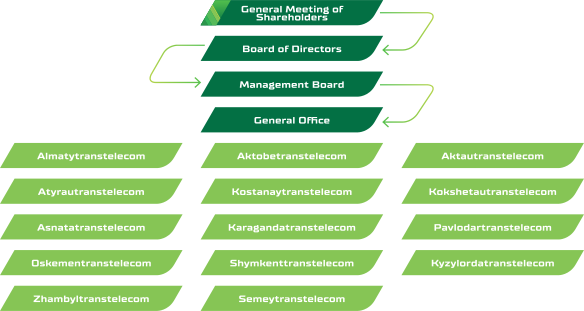
Organizational structure
In 2020, a new organizational structure was implemented to improve Company’s business efficiency and successfully overcome new market challenges. The proposed structure is based on the methodology of change management of the Adizes Institute and is built so that it can quickly respond to changes in the external environment, innovation and aims at the accumulation of unique competencies.
When developing the new version of the organizational structure of the Company’s central office, we proceeded from the following principles:
- compliance with the approved development strategy;
- business focus on profit centers;
- customer focus and increasing customer loyalty;
- reducing the hierarchical load;
- strengthening the product focus and stabilization of revenues;
- separation of development and operation functions;
- exclusion of conflicts of interest.
In order to reduce the distance from the source of profit, a flatter structure by business areas is proposed, whose main advantage is its ability to quickly respond and adapt to changes in the external environment, innovation and the accumulation of unique competencies. The flat organizational structure of company management implies that fewer people are involved in the decision-making process. Decisions are made by managers with relevant information and authority based on the area/customer being supervised.
Implementing the Development Strategy, the Company switches to a mixed business model when the project business model used by the Company is complemented by a product business model focused on mass customers, both private and business customers. In this regard, the proposed structure provides for a dedicated Product Office, which acts as a competence center for the development and implementation of the latest technologies in the field of ICT, which will strengthen the product focus of business and stabilize the flow of income (recurring revenues), respectively, without being limited to one-time projects.
Organizational structure as of December 31, 2020