Environmental Initiatives and Approach to Environmental Protection
Environmental protection activities of Transtelecom JSC are carried out in accordance with the Environmental Code of Republic of Kazakhstan and other regulatory legal acts in the field of environmental protection.
The Company does not cause direct significant harm to the environment through its activities and does not conduct business in potentially environmentally hazardous industries. Nevertheless, we understand that the tasks of improving the energy efficiency of operations, resource conservation, and minimizing the negative impact on the environment are relevant for the Company, as a leading player in the telecommunications and IT market operating throughout Kazakhstan.
In 2020, environmental protection was ensured within the framework of developed and approved standards, regulations, instructions aimed at complying with the requirements of national laws and assumed international obligations. Transtelecom JSC strives to minimize its environmental impact and apply the most advanced technologies for managing such impact.
In order to improve the environmental management system and increase environmental responsibility at all stages of the production process, the Company has implemented international environmental management standards (hereinafter – EMS) ISO 14001 and energy management standards (hereinafter – EnMS) ISO 50001.
The Company’s management has assumed responsibility for the implementation of the Environmental Policy, undertakes to continually improve the effectiveness of the environmental management system and assures that each employee of the Company is personally responsible for compliance with the legally established environmental requirements and norms. In carrying out its activities in the field of telephone and telegraph services, IP-telephony services, telecommunications services, creation and operation of communication networks, the Company is fully aware that its activities have an impact on the environment.
No prescriptive regulatory comments were received for the period 2019-2020.
For 2020, there are no penalties and other non-financial sanctions imposed for non-compliance with environmental legislation.
Use of Energy Resources and Energy Conservation
Introducing new technologies instead of outdated ones, the Company gives preference to resource-saving and environmentally friendly technologies. The Company has carried out an energy analysis. Based on the analysis of the use and consumption of energy resources for the base year 2019-2020, the Company identified areas of significant energy consumption: electricity, heat, fuel. These types of energy also provide potential for improving energy efficiency.
The main indicators of energy efficiency are as follows: electric power consumption for the equipment of FOCL and telegraph and telephone stations and own needs, thermal power consumption, gasoline consumption by motor vehicles when servicing the equipment of FOCL and telegraph and telephone stations and own needs, diesel fuel consumption by motor vehicles when servicing the equipment of FOCL and telegraph and telephone stations and own needs.
The total consumption of heat
energy in 2020 amounted to
Gcal
Actual electricity
consumption
kWh
Energy Efficiency Indicators in TTC for 2020
| Indicators | W FOCL | W telegraph and telephone station and own needs N | Q h. e. | V gasoline | V diesel fuel |
|---|---|---|---|---|---|
| January | 36.55 | 22.49 | 0.04 | 4.92 | 0.71 |
| February | 36.23 | 22.52 | 0.04 | 4.99 | 0.48 |
| March | 31.95 | 18.65 | 0.03 | 5.74 | 0.46 |
| April | 31.65 | 17.37 | 0.01 | 5.34 | 0.59 |
| May | 30.49 | 17.85 | 0.00 | 5.24 | 0.50 |
| June | 31.64 | 19.09 | 0.00 | 5.12 | 0.26 |
| July | 36.51 | 19.24 | 0.00 | 5.36 | 0.50 |
| August | 32.32 | 20.41 | 0.00 | 5.08 | 0.92 |
| September | 35.17 | 19.61 | 0.00 | 5.30 | 0.74 |
| October | 29.39 | 19.58 | 0.02 | 5.60 | 0.92 |
| November | 32.14 | 20.73 | 0.03 | 5.49 | 1.00 |
| December | 33.10 | 21.05 | 0.04 | 6.20 | 0.91 |
| Total/Average | 33.10 | 19.88 | 0.02 | 5.37 | 0.67 |
Indicator of electrical energy W FOCL
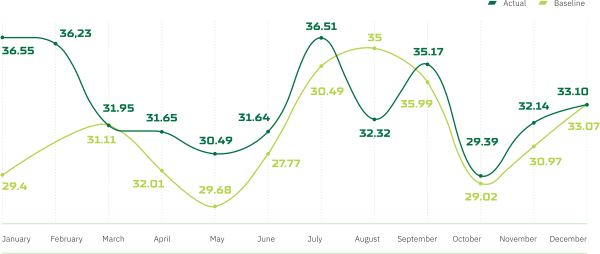
TOTAL fact. FOCL
33.10TOTAL basic. FOCL
31.56In 2020 (33.1), a 1% decrease in the W FOCL indicator relative to 2019 (31.56) has not been achieved because there has been an increase of 54,779.3 kWh of W FOCL electricity consumption from 5,204,749.7 kWh to 5,259,529 kWh.
Energy Efficiency Monitoring for 2019-2020
| Types of fuel and energy resources | UoM | 2019 | 2020 | Difference (+/-) 2019/2020 | Deviations,% 2019/2020 |
|---|---|---|---|---|---|
| Electricity | kWh | 12,570,220 | 12,729,196 | 158,976 | 5.3 |
| Heat | Gcal | 4,428 | 4,360 | - 68 | 11.45 |
| Diesel fuel | tons | 130,523 | 106,081 | - 24 442 | 8.81 |
| Gasoline | tons | 852,520 | 860,617 | 8,097 | 0.95 |
Air Emissions and Climate Change
The telecommunications industry has a relatively low environmental impact compared to other industries. However, due to the growing importance of global and local environmental problems, Transtelecom JSC aims to implement measures to compensate for damage from its activities by minimizing direct and indirect environmental impact.
To manage the environmental aspect, the company has created an environmental management system (EMS), which is an integral part of the corporate governance system and an essential part of the non-financial risk management system. The Company is certified for compliance with the international standard ISO 14001 and is constantly improving the EMS.
As part of production activities, all enterprises of the Company obtain appropriate permits, and statistical information is provided to the supervisory authorities on an annual basis.
The total amount of pollutant emissions into the atmosphere in 2020 amounted to 790.4527 tons.
The activities of the Company have no negative impact on flora and fauna. The Company does not have facilities located in the territories of state national natural parks or reserves, in specially protected natural areas.
The amount of water
consumed in 2020 is
Emissions of Gaseous Pollutants by Branches in 2020
| № | Branches | Actual volume, ton | Amount for emission into the environment, tenge |
|---|---|---|---|
| 1 | CO | 45.895 | 263,733.00 |
| 2 | AstanaTTC | 52.87 | 105,644.08 |
| 3 | AlmatyTTC | 96.6447 | 188,480.00 |
| 4 | AktobeTTC | 81.75 | 266,909.00 |
| 5 | AktauTTC | 37.335 | 121,351.00 |
| 6 | AtyrauTTC | 28.807 | 156,574.41 |
| 7 | ZhambylTTC | 56.8 | 130,170.00 |
| 8 | KaragandaTTC | 96.59 | 305,477.00 |
| 9 | KostanayTTC | 35.14 | 61,900.00 |
| 10 | KokshetauTTC | 58.39 | 112,807.00 |
| 11 | KyzylordaTTC | 34.005 | 61,618.00 |
| 12 | OskemenTTC | 36.77 | 67,007.00 |
| 13 | PavlodarTTC | 43.695 | 117,564.00 |
| 14 | SemeyTTC | 41.54 | 75,411.00 |
| 15 | ShymkentTTC | 44.221 | 79,902.45 |
| Total | 790.4527 | 2,114,547.94 |
Resource Saving
Every year, the Company continues to reduce the impact of its operations on the environment through reasonable use of resources, particularly water and paper, in the Company’s offices and branches.
Paper consumption is reduced due to the electronic document management system and electronic memos. In addition, we encourage the use of electronic media instead of paper in our daily work, and all printing and copying equipment settings default to economy mode.
The Company promotes ecological culture in the company as the basis for a more responsible attitude of people towards the environment. The Company actively supports environmental initiatives of representatives of local communities that form a responsible attitude towards nature and aimed at nature conservation, its study and restoration. Employees of Transtelecom JSC act as volunteers, taking part in projects for landscaping, gardening and cleaning areas. Every year in May a clean-up event is held.
The Company’s activities do not have a significant impact on water intake; however, we strive to reduce the use of water.
For the water supply of the Company’s units, water is mainly used from the networks of water supply organizations. Water is withdrawn from two original sources – groundwater (wells) and surface water (rivers, lakes, sea), which are protected by the Ministry of Environmental Protection of the Republic of Kazakhstan.
Reuse of water in the production process of providing telecommunications services by the units of the Company is not applied. Transtelecom JSC uses water only for sanitary and household needs. Installed water meters are kept in technically corrected condition.